


How AWG Performs in Extreme Gulf Summer Humidity 🌤️💧
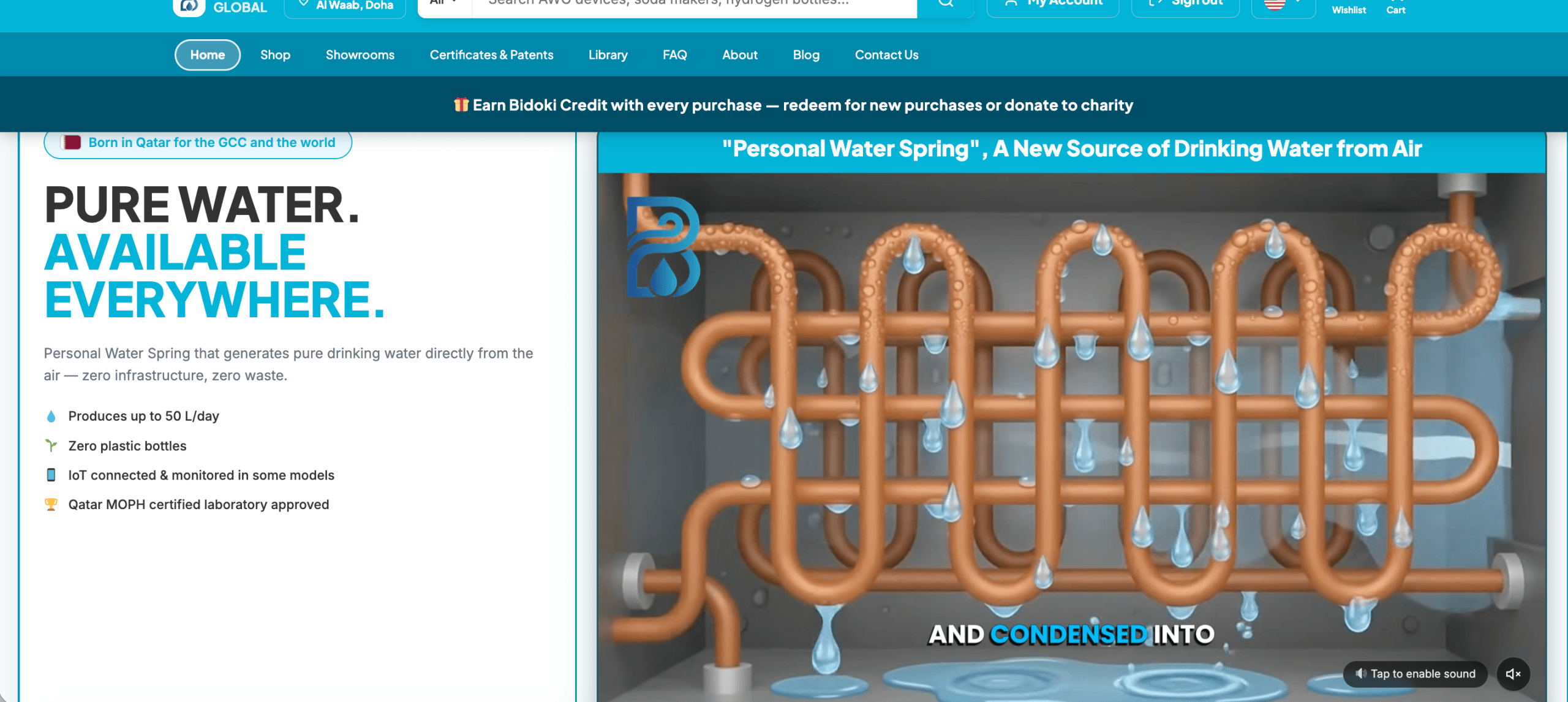
The Science of How the “Personal Water Spring” Turns Sticky Air into Pure Drinking Water
If you have ever stepped outside during a Doha summer evening, you know exactly what the Gulf’s extreme humidity feels like. It hits you like a warm, sticky blanket, and within seconds, your sunglasses fog up completely!
While that heavy, damp air makes walking outside difficult, it is actually the ultimate goldmine for an Atmospheric Water Generator (AWG)—like the Personal Water Spring. To an AWG device, that thick air is a massive, floating reservoir of pure water waiting to be harvested.
But how do these machines handle the intense climate of the GCC? Why do they thrive in indoor environments, and how do they perform across different seasons in Qatar? Let’s dive into the fascinating science of air-harvesting, break down the two core technologies, and look at the real numbers behind your water.
              THE HUMIDITY HARVEST MATRIX 📊✨
 ┌─────────────────────────────────────────────────────────────┐
 │  HIGH RH (% of water air CAN hold) = Maximum Water Harvest  │
 │  HIGH ABSOLUTE HUMIDITY (Grams of water per m³) = More Drops │
 ├─────────────────────────────────────────────────────────────┤
 │  AC CLIMATE BALANCE:                                        │
 │  Standard Home AC cools to ~23°C ➔ Leaves indoor RH at ~45% │
 │  Personal Water Spring operates perfectly down to 35% RH!    │
 ├─────────────────────────────────────────────────────────────┐
 │  THE GCC EFFICIENCY RULE:                                   │
 │  Lower Temperatures (< 35°C) = Faster, Easier Condensation! │
 └─────────────────────────────────────────────────────────────┘
1. The Science of the “Sticky Air” (RH vs. Absolute Humidity)
To understand how a Personal Water Spring works, we need to unlock two simple terms that weather scientists use every day:
-
- Relative Humidity (RH): This is the percentage (%) you see on your phone’s weather app. It tells us how full of water the air currently is compared to the maximum amount it could hold at that specific temperature. If the RH is 80%, the air is almost completely packed with moisture!
- Absolute Humidity (Grams per \(m^{3}\)): This is the actual weight of the water hiding inside the air. It measures exactly how many grams of invisible water vapor are floating inside every single cubic meter (\(m^{3}\)) of air around you.
The rule is very simple: The higher the RH and the more grams of water per cubic meter, the more drinking water your device can generate!
2. The Great Indoor Balance: Working Alongside Your Home AC
A very common question people ask is: “If my home or office Air Conditioner (AC) is already running and pulling moisture out of the air, will a Personal Water Spring still work indoors?”
Yes, absolutely!
While it is true that home AC units naturally remove some humidity as they cool a room down, they never strip the air completely dry. In Qatar, a standard indoor room cooled by an AC typically maintains a comfortable climate of around 22°C to 24°C with an indoor relative humidity of about 40% to 50%.
Because the Bidoki Personal Water Spring is engineered to operate efficiently anywhere above 35% RH, it functions beautifully right inside your air-conditioned living room or office! It seamlessly captures that remaining indoor moisture and recycles it into a cold, pristine glass of drinking water.
3. Battle of the Technologies: Refrigeration vs. Desiccants
Across the world, engineers use two main methods to pull water out of the air. Understanding the difference helps explain why our new inventions are so exciting:
Technology 1: Water Vapor Condensation (The Cooling Cycle)
This is the most common technology used today, operating exactly like a refrigerator. The machine uses a compressor and a refrigeration cycle to pump cooling fluid through metal coils, making them freezing cold. When warm air is blown across these coils, the temperature drops below the dew point, and water vapor instantly condenses into liquid droplets.
-
- The Limitation: This method is highly effective in humid regions, but it struggles in bone-dry environments. If the relative humidity drops too low (under 30–35%), the air doesn’t have enough water weight to condense easily, causing the machine to work much harder or stop producing altogether.
Technology 2: Desiccant Absorption (The Moisture Sponge)
Instead of freezing the air, this method uses a chemical “sponge”—called a desiccant or advanced materials known as MOFs (Metal-Organic Frameworks)—to physically absorb and trap water molecules out of the air, which are then baked out using heat.
🔮 The Future: Bidoki’s Patent-Pending Technology
While current refrigeration technology is fantastic for the humid coastal cities of the GCC, Bidoki Global has developed a patent-pending hybrid technology. By combining advanced materials and smart thermodynamics, our next-generation systems are specifically designed to shape the future of water harvesting in ultra-low humidity and deep desert areas, completely erasing the old limits of traditional air-water generation!
4. Season by Season: Qatar’s Yearly Humidity Tracker
Fortunately for residents of the GCC, our coastal geography means there is an abundance of water vapor floating in the air for most of the year. However, the way your machine performs changes across the seasons.
When an AWG factory rates a machine’s capacity (such as a 50-liter-per-day unit), that rating is measured at a standard baseline of 25°C and 80% RH.
Here is how Qatar’s monthly relative humidity averages look, and how it impacts your water harvest:
                  QATAR'S MONTHLY HUMIDITY RHYTHM 📅

  [SUMMER]     Jun: ~40% RH | Jul: ~45% RH | Aug: ~55% RH
               ➔ Extreme heat (often > 40°C) means the air holds tons of total water,
                 but the high heat requires more energy to cool down.

  [AUTUMN]     Sep: ~60% RH | Oct: ~65% RH | Nov: ~70% RH  ⭐ MAXIMUM HARVEST ⭐
               ➔ The sweet spot! Warm air combined with surging coastal humidity
                 creates massive water yields.

  [WINTER]     Dec: ~75% RH | Jan: ~75% RH | Feb: ~70% RH  ⭐ HIGHEST EFFICIENCY ⭐
               ➔ Temperatures drop below 25°C. Because cooler air is much easier
                 for the machine to chill, water production is incredibly efficient!

  [SPRING]     Mar: ~65% RH | Apr: ~55% RH | May: ~45% RH
               ➔ Transition months with highly steady, reliable indoor generation.
Because temperatures under 35°C make it significantly easier for a refrigeration cycle to cool down the air, your Personal Water Spring will actually achieve its highest and most efficient water generation during the Autumn and Winter months when the desert heat cools down but the sea gulf humidity remains high!
5. Energy and Economics: The Real Math
When evaluating an AWG, it is important to understand how much electricity it uses and what you are comparing it against.
-
- Kilowatt-Hours (kWh) Per Liter: Depending on the indoor temperature and humidity levels, a modern, well-engineered AWG requires roughly 0.3 to 0.5 kWh of electricity to generate one liter of pure water.
- The True Cost Comparison: This electricity footprint means that AWG water should never be compared to cheap tap water coming from municipal bulk desalination plants (which is meant for washing dishes, taking showers, and flushing toilets). Instead, your Personal Water Spring is a direct replacement for commercial bottled water.
When compared to the financial cost of driving to the store, paying the 2,000% markup on plastic single-use bottles, and dealing with delivery subscriptions, generating your own premium water from the air is highly cost-effective, vastly healthier, and incredibly kind to our environment!
References
-
- Wahby, M., et al. (2021). Atmospheric water generation: A review of technological advancements and energy efficiency. Renewable and Sustainable Energy Reviews, 150, 111475. (Explains how refrigeration cycles cool air to reach the dew point) [doi.org].
- Malaeb, L., & Ayoub, G. M. (2011). Reverse osmosis and condensation technologies for water treatment. Desalination, 267(1), 1-8. (Details how temperature and relative humidity alter condensation rates) [doi.org].
- Qatar Meteorological Department. (2025). Climatological Summary and Relative Humidity Historical Data Assets. (Source for Qatar’s annual monthly humidity and temperature averages).
- Gleick, P. H. (2006). Energy implications of alternative bottled water supply chains. Environmental Research Letters. (Outlines why on-site point-of-use generation is economically superior to bottled distribution) [doi.org].
- Kim, H., et al. (2017). Water harvesting from air with metal-organic frameworks powered by natural sunlight. Science, 356(6336), 430-434. (The foundational scientific paper explaining how advanced desiccant and MOF systems absorb moisture in dry climates) [doi.org].