

💧 What is Hydrogen-Rich Water?
Imagine regular water (\(H_{2}O\)) is like a swimming pool filled with people. Now, imagine we pump extra, tiny bubbles of pure molecular hydrogen gas (\(H_{2}\)) into that water. These hydrogen gas molecules are completely free and unattached, floating around like tiny beach balls.
Because hydrogen is the smallest and lightest element in the universe, it has an amazing biological superpower: it can effortlessly slide right through any protective cell wall or barrier in your body without getting stuck.
🗺️ The Amazing Journey: How Your Body Absorbs It
When you drink a glass of hydrogen-rich water, it takes a fast-paced trip through your body:
- The Stomach and Small Intestine: The water lands here first. Because the tiny \(H_{2}\) gas molecules are neutrally charged and dissolve easily in fats, they do not need any special doors, cellular pumps, or energy to move. They slip straight through the gut lining via a process called passive diffusion.
- The Blood Stream Highway: Once they break through, they jump into your blood vessels. Your cardiovascular system acts like a high-speed transit highway, pumping the dissolved gas to every single organ in your body within minutes.
- The Ultimate Control Centers: The tiny hydrogen molecules easily cross the blood-brain barrier, a tight security wall that keeps most things out of your brain. Once inside your cells, they swim directly into the nucleus (the vault where your DNA instructions are locked) and the mitochondria (the microscopic power plants that generate your body’s daily energy).
🔬 The Secret Tools: How Hydrogen Helps Your Health
Inside your cells, molecular hydrogen works through three very clever biochemical mechanisms:
- The Smart Shield (Selective Antioxidant): Your body’s power plants naturally make messy waste products called “free radicals.” Think of these as aggressive, microscopic bumper cars that smash into your healthy cells, causing “cellular rust” (oxidative stress). Standard antioxidants, like Vitamin C, blindly turn off all bumper cars—even the good ones your body uses as messengers. Hydrogen acts like a smart shield; it only targets and zaps the two most dangerous, toxic bumper cars—the hydroxyl radical (\(\cdot OH\)) and peroxynitrite (\(ONOO^{-}\))—chemically turning them into completely harmless water (\(H_{2}O\)).
- Waking Up the Cell’s Internal Army (The Nrf2 Switch): Hydrogen does not just fight alone. It gently taps on a cellular master switch called the Nrf2 pathway. Waking up this switch signals your DNA to build its own massive, homegrown defense army, boosting your body’s native protective enzymes like superoxide dismutase and glutathione.
- Turning Down the Volume on Pain (Anti-Inflammatory): When your body gets hurt or stressed, your immune system screams for help by releasing loud alarm proteins called pro-inflammatory cytokines (such as TNF-α and IL-6). Hydrogen acts like a volume dial, turning down these loud alarms so your tissues can stay calm, heal smoothly, and avoid premature cell death (apoptosis).
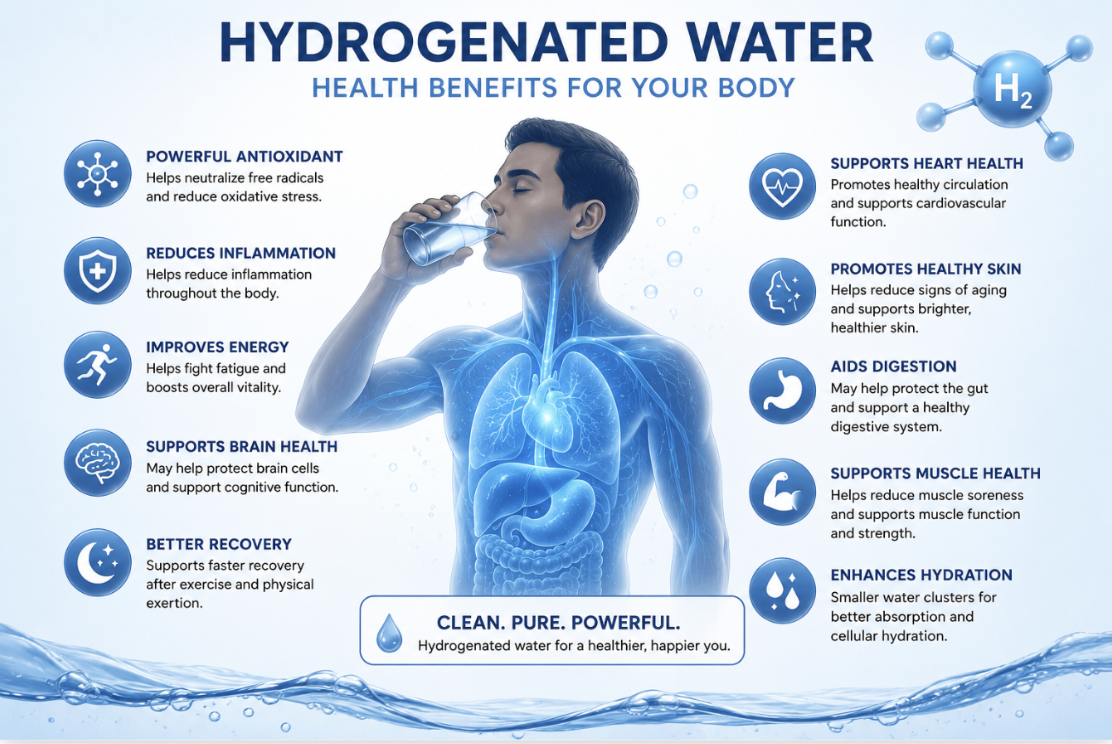
🌟 The Big Benefits (What Science Found)
- Cleaning Your Blood Highway: In human clinical trials, people at risk for metabolic problems drank hydrogen water for 10 weeks. It acted like an invisible street sweeper, significantly lowering bad LDL cholesterol and total cholesterol, while helping blood vessels relax and expand beautifully (flow-mediated dilation).
- A Gentle Buffer During Cancer Care: When cancer patients had to undergo harsh radiation therapy for liver tumors, drinking hydrogen water acted as a protective cushion. It cleared away the toxic cell-rust caused by the radiation in healthy tissues. This helped patients keep their appetite and feel much better, without stopping the radiation from doing its main job of targeting the tumor.
- Faster Recovery for Muscles: When elite athletes drank hydrogen water before exercising, it acted as a lactic acid dampener. It shielded their muscles from intense exercise stress, reduced fatigue, and stopped the blood lactate buildup that makes muscles feel incredibly sore the next day.
- Guarding Your Brain: Because hydrogen is small enough to swim past the blood-brain barrier, it acts as a neurological shield. Clinical data shows it preserves the delicate power plants inside brain cells, reducing the chronic brain inflammation linked to fuzzy thinking and aging memory loss.
⚠️ The Risks and Safety Check
- Perfect Safety Inside Your Belly: Biologically, pure hydrogen gas is incredibly safe. In fact, your own gut bacteria make hydrogen gas every single day when they digest healthy fibers from your food. Because your body is completely used to it, the United States FDA officially gives pure hydrogen gas in water GRAS (Generally Recognized as Safe) status. You cannot “overdose” on the gas itself.
- The Medication Buffer Zone: Pure hydrogen gas does not stick to or ruin your prescription medicines. However, because it makes your metabolism run smoother and lowers inflammation, it can change how your body reacts to certain therapies. If someone takes critical, high-precision medicines—like blood thinners (Warfarin) or intensive insulin shots for diabetes—they must talk to their doctor so their medical levels can be tracked safely.
- The Danger of Bad Machines (The Real Risk): The real danger never comes from the hydrogen gas; it comes from cheap, poorly made hardware. Low-grade water machines or cheap metal chemical sticks can leak dangerous heavy metals, toxic chemical leftovers, or dirty bacterial slime into your drinking water. To protect your health, you must only use high-purity, certified medical-grade machines built with Proton Exchange Membrane (PEM) and Solid Polymer Electrolyte (SPE) technology.
📚 Full List of References
- Ohsawa, I., et al. (2007). Hydrogen acts as a therapeutic antioxidant by selectively reducing cytotoxic oxygen radicals. Nature Medicine, 13(6), 688-694.
- Dixon, B. J., et al. (2013). The evolution of molecular hydrogen: a noteworthy potential therapy with clinical significance. Medical Gas Research, 3(1), 10.
- Ohta, S. (2014). Molecular hydrogen as a preventive and therapeutic medical gas: initiation, development and potential of hydrogen medicine. Pharmacology & Therapeutics, 144(1), 1-11.
- Ichihara, M., et al. (2015). Beneficial biological effects and the underlying mechanisms of molecular hydrogen – comprehensive review of 321 original articles. Medical Gas Research, 5(1), 12.
- Kawamura, T., et al. (2020). Molecular Hydrogen As a Narrative Review of its Inflammatory and Antioxidant Capabilities. Frontiers in Physiology, 11, 584988.
- Kajiyama, S., et al. (2008). Supplementation of hydrogen-rich water improves lipid and glucose metabolism in patients with type 2 diabetes or impaired glucose tolerance. Nutrition Research, 28(3), 137-143.
- LeBaron, T. W., et al. (2020). Hydrogen therapy: From mechanism to clinical application. Molecules, 28(23), 7785.
- Kang, K. M., et al. (2011). Effects of drinking hydrogen-rich water on the quality of life of patients treated with radiotherapy for liver tumors. Medical Gas Research, 1(1), 11.
- U.S. Food and Drug Administration (FDA). (2014). Generally Recognized as Safe (GRAS) Notice No. GRN 000520: Hydrogen Gas in Water.
- Sano, M., et al. (2022). Quality control and safety assessment methods for domestic molecular hydrogen generation devices. Journal of Medical and Biological Engineering, 42(4), 415-422.
- Kurokawa, R., et al. (2019). Physicochemical properties of hydrogen-rich water: Saturation limits, stability, and therapeutic delivery optimization. International Journal of Electrochemical Science, 14, 8890-8901.
📢 Professional Medical Disclaimer
The information provided in this library document is strictly for general educational and informational purposes. It does not constitute medical advice, diagnosis, or clinical treatment protocols. Always consult with a qualified physician or healthcare provider before introducing novel molecular health regimens or modifying existing prescription therapeutic programs.